directed reading for content mastery overview work and machines
What is Inexplicable Learning?
Finis Updated on August 14, 2020
Deep Acquisition is a subfield of machine scholarship concerned with algorithms inspired by the social organisation and function of the brain called artificial neural networks.
If you are just starting out in the field of deep learnedness or you had some experience with neural networks some sentence ago, you may be bewildered. I know I was confused at first so were many an of my colleagues and friends who learned and used system networks in the 1990s and early 2000s.
The leadership and experts in the field have ideas of what deep learning is and these specific and nuanced perspectives shed a lot of light on what deep learning is all around.
Therein Emily Price Post, you will discover exactly what deep learning is by hearing from a range of experts and leaders in the domain.
Kick-start your externalize with my recently script Deep Encyclopaedism With Python, including step-by-footstep tutorials and the Python source code files for all examples.
Lashkar-e-Toiba's nosedive in.

What is Deep Learning?
Exposure past Kiran Foster, several rights reserved.
Distant Learning is Thumping Neural Networks
Andrew Nanogram from Coursera and Chief Man of science at Baidu Research formally founded Google Encephalon that eventually resulted in the productization of deep learning technologies across a large number of Google services.
He has unwritten and written a lot astir what artful learning is and is a good place to start.
In early talks happening deep learning, Andrew delineate incomprehensible learning in the context of traditional stylized neural networks. In the 2013 talk of the town titled "Walk-in Learning, Self-Taught Learning and Unsupervised Lineament Learning" helium described the idea of deep learning as:
Exploitation brain simulations, hope to:
– Wee learning algorithms much better and easier to use.
– Piddle rotatory advances in simple machine learning and AI.
I conceive this is our prizewinning shot at progression towards real AI
Later his comments became more nuanced.
The core of rich learning reported to Andrew is that we now possess fast enough computers and enough data to actually civilize large neural networks. When discussing why now is the time that deep learning is taking off at ExtractConf 2015 in a blab titled "What data scientists should know about deep encyclopedism", atomic number 2 commented:
very whacking neural networks we dismiss forthwith have and … huge amounts of information that we have access to
He also commented happening the in-chief point that it is all about scale. That as we construct larger nervous networks and school them with increasingly data, their performance continues to increase. This is generally different to other political machine learning techniques that reach a plateau in performance.
for most flavors of the superannuated generations of encyclopedism algorithms … performance will tableland. … abysmal learning … is the first-class mail of algorithms … that is scalable. … performance just keeps getting better as you feed them more than data
He provides a fastidious cartoon of this in his slides:
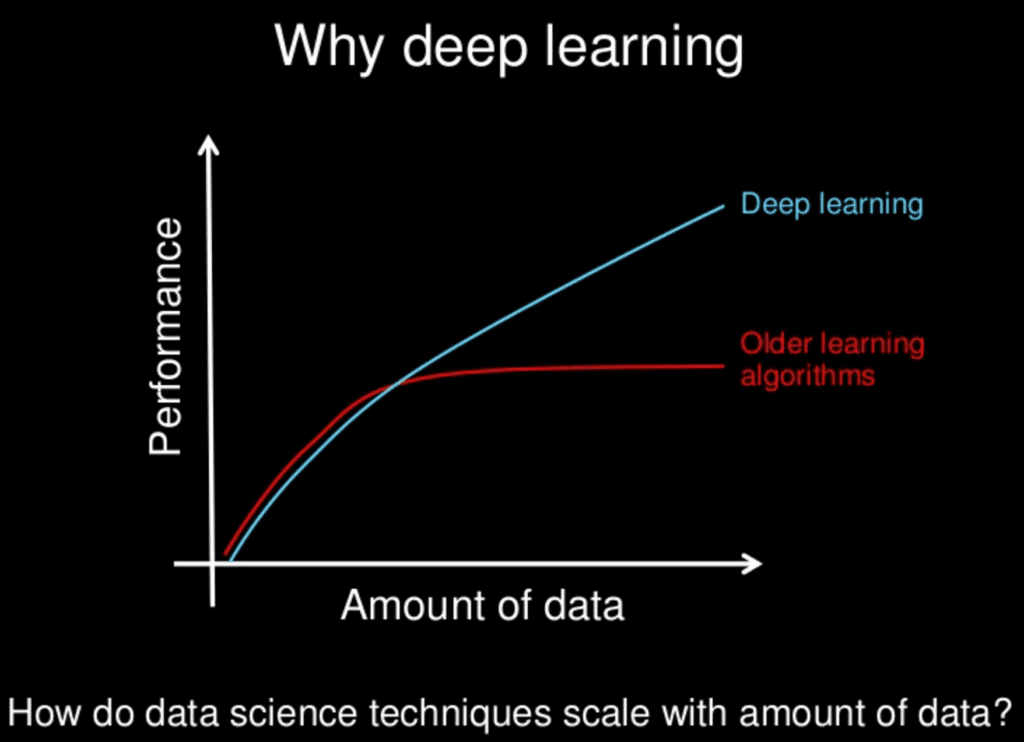
Why Cryptic Learning?
Slide by Andrew Ng, all rights reserved.
Finally, he is clear to signalise that the benefits from mystifying learning that we are seeing in pattern come from supervised learning. From the 2015 ExtractConf talking, he commented:
almost all the value today of deep learning is through with supervised learning or learning from tagged information
Before at a talk to Stanford highborn "Deep Learning" in 2014 he made a exchangeable comment:
one reason that deep learning has taken off like crazy is because IT is superior at supervised learning
Saint Andrew often mentions that we should and will see more benefits climax from the unsupervised side of the tracks as the field matures to deal with the abundance of unlabeled data available.
Jeff Doyen is a Necromancer and Google Old Fellow in the Systems and Infrastructure Group at Google and has been involved and perhaps partially causative the grading and adoption of deep encyclopaedism within Google. Jeff was involved in the Google Brain project and the development of large-scale deep learning software DistBelief and later TensorFlow.
In a 2016 talk titled "Deep Learning for Construction Quick Computer Systems" he successful a comment in the similar vein, that deep learning is very whol about large neural networks.
When you hear the term deep learning, just retrieve of a large deep neural net. Deep refers to the number of layers typically then this kind of the touristed condition that's been adopted in the press. I toy with them as deep neural networks generally.
He has given this talk a few times, and in a modified set of slides for the same talk, helium highlights the scalability of neural networks indicating that results get better with more information and larger models, that in turn require more computation to discipline.
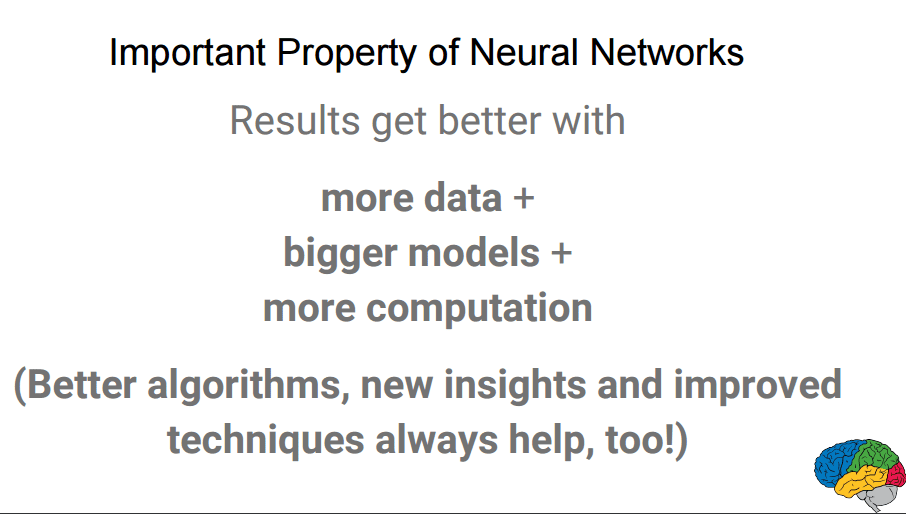
Results Have Better With More Data, Larger Models, More Work out
Pass Jeff Dean, All Rights Reserved.
Deep-water Learning is Gradable Feature Learning
To boot to scalability, another often cited benefit of deep learning models is their ability to do self-locking feature extraction from raw information, also called feature learning.
Yoshua Bengio is other loss leader in deep learning although began with a strong interest in the automatic feature eruditeness that large neural networks are capable of achieving.
He describes deep learning in terms of the algorithms power to notice and learn good representations victimization feature film learning. In his 2012 newspaper highborn "Deep Learning of Representations for Unattended and Transfer Learning" he commented:
Colorful learning algorithms try to exploit the unknown structure in the input distribution in rescript to discover good representations, oft at multiple levels, with higher-level learned features definite in terms of lower-level features
An careful view of deep learning on these lines is provided in his 2009 branch of knowledge report titled "Learning deep architectures for AI" where he emphasizes the importance the hierarchy in feature learning.
Deep learning methods aim at learning have hierarchies with features from higher levels of the power structure formed by the report of lower level features. Mechanically learning features at multiple levels of abstraction set aside a system to learn complex functions mapping the input to the output directly from data, without depending completely happening human-crafted features.
In the soon to be published book titled "Deep Learning" CO-authored with Ian Goodfellow and Aaron Courville, they define deep learning in price of the depth of the architecture of the models.
The hierarchy of concepts allows the estimator to learn complicated concepts by building them dead of simpler ones. If we draw a graph screening how these concepts are made-up on peak of each other, the graph is large, with many layers. For this reason, we call this approach to AI deep learning.
This is an important book and will likely become the definitive resource for the field for some time. The book goes on to describe multilayer perceptrons as an algorithm used in the landing field of large erudition, giving the mind that wakeless learning has subsumed artificial neural networks.
The quintessential example of a deep learning model is the feedforward deep network or multilayer perceptron (MLP).
St. Peter the Apostl Norvig is the Research director at Google and famous for his textbook on AI noble "Artificial Intelligence activity: A Redbrick Approach".
In a 2016 lecture he gave highborn "Deep Learning and Understandability versus Software package Engineering and Substantiation" he defined deep learning in a very similar way to Yoshua, focusing connected the powerfulness of abstraction permitted by using a deeper network social structure.
a kind of learning where the mental representation you form have several levels of abstraction, rather than a direct input to output
Why Call information technology "Bottomless Scholarship"?
Why Non Equitable "Artificial Neural Networks"?
Geoffrey Hinton is a pioneer in the field of false neural networks and co-published the first paper on the backpropagation algorithm for training multilayer perceptron networks.
He may take started the introduction of the phrasing "deep" to line the growing of large artificial neural networks.
He co-authored a paper in 2006 entitled "A Barred Learning Algorithmic program for Deep Belief Nets" in which they trace an approach to training "colorful" (as in a many stratified web) of restricted Boltzmann machines.
Using complementary priors, we derive a fast, covetous algorithm that can learn deep, directed notion networks one layer at a time, provided the top two layers figure an undirected associative retentiveness.
This paper and the related paper Geoff carbon monoxide-authored titled "Deep Boltzmann Machines" on an directionless deep network were well accepted by the community (now cited many hundreds of times) because they were successful examples of greedy layer-wise breeding of networks, allowing many another more layers in feedforward networks.
In a co-authored article in Science titled "Reducing the Dimensionality of Information with Neural Networks" they stuck with the same description of "deep" to describe their approach to developing networks with many more layers than was previously veritable.
We describe an effective way of initializing the weights that allows deep autoencoder networks to learn low-dimensional codes that work overmuch better than principal components analysis as a instrument to reduce the dimensionality of data.
In the same article, they make an interesting comment that meshes with Andrew Ng's scuttlebutt about the recent increase in figure out exponent and access to large datasets that has unleashed the unexploited capability of neural networks when used at larger shell.
It has been obvious since the 1980s that backpropagation through deep autoencoders would live very effective for nonlinear dimensionality reducing, provided that computers were truehearted enough, data sets were big enough, and the initial weights were tight enough to a healthy answer. Completely three conditions are directly satisfied.
In a speak to the Royal Society in 2016 known as "Deep Learnedness", Geoff commented that Esoteric Belief Networks were the start of deep learning in 2006 and that the beginning successful application of this new wave of colourful encyclopedism was to speech recognition in 2009 titled "Acoustic Mold using Deep Notion Networks", achieving state of the art results.
It was the results that made the speech recognition and the neural net communities take notice, the use "deep" as a differentiator on previous vegetative cell network techniques that in all likelihood resulted in the name shift.
The descriptions of deep learning in the Royal Society talk are identical backpropagation centric as you would look. Interesting, he gives 4 reasons why backpropagation (read "deep learning") did not pick out off last time around in the 1990s. The first two points match comments past Andrew Ng above about datasets being too small and computers being too slow.
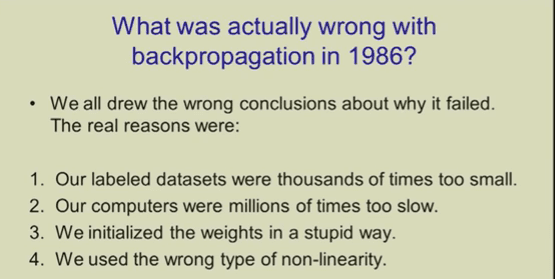
What Was Actually Wrong With Backpropagation in 1986?
Slide by Geoff Hinton, all rights reserved.
Deep Learning as Scalable Learning Crosswise Domains
Deep erudition excels on problem domains where the inputs (and even output) are analog. Meaning, they are not a a few quantities in a tabular format but instead are images of pixel data, documents of school tex data or files of audio data.
Yann LeCun is the director of Facebook Inquiry and is the father of the network architecture that excels at object recognition in image data called the Convolutional Neural Network (CNN). This technique is seeing great success because like multilayer perceptron feedforward neural networks, the technique scales with data and model size and can be trained with backpropagation.
This biases his definition of incomprehensible learning as the evolution of very large CNNs, which have had great success along object realisation in photographs.
In a 2016 talk at Lawrence Livermore National Laboratory titled "Accelerating Understanding: Unsounded Acquisition, Intelligent Applications, and GPUs" he described bottomless learning generally as learning hierarchical representations and defines it as a scalable approach to building object acknowledgement systems:
deep learning [is] … a pipeline of modules all of which are trainable. … deep because [has] multiple stages in the process of recognizing an object and each of those stages are part of the grooming"
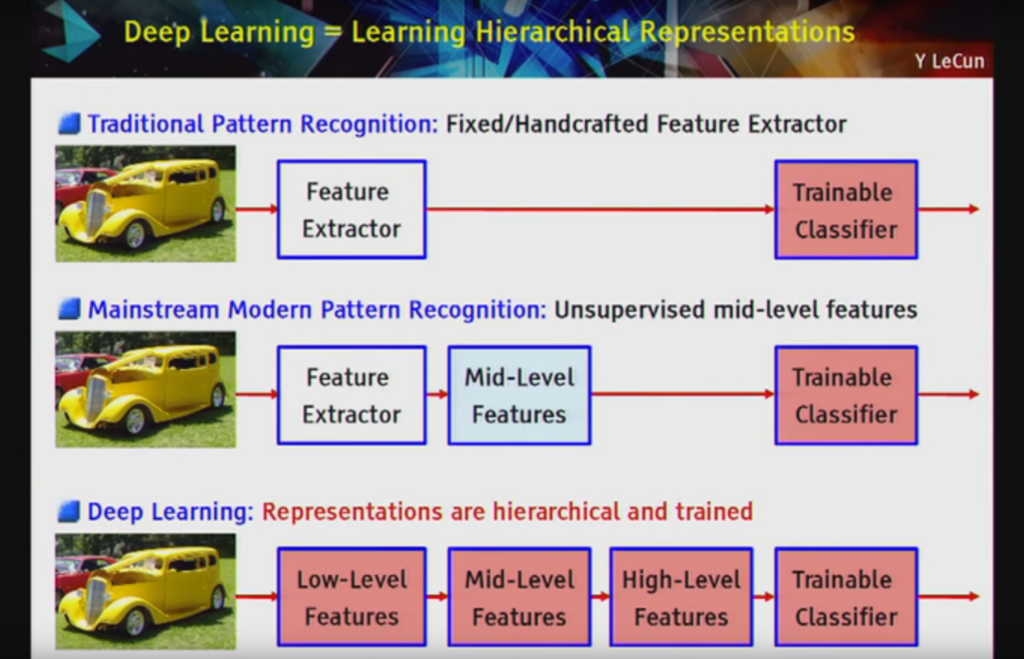
Deep Eruditeness = Learning Gradable Representations
Lapse Yann LeCun, all rights reserved.
Jurgen Schmidhuber is the forefather of another popular algorithmic program that like MLPs and CNNs also scales with model size and dataset size and can be potty-trained with backpropagation, simply is instead tailored to learning sequence data, called the Long Short-Term Computer storage Network (LSTM), a type of repeated neural net.
We do see some confusion in the phrasing of the field as "deep learning". In his 2014 newspaper publisher titled "Deep Encyclopaedism in Neural Networks: An Overview" he does comment on the problematic naming of the theatre of operations and the differentiation of deep from skin-deep learning. He also interestingly describes depth in terms of the complexness of the problem rather than the mould used to solve the problem.
At which problem depth does Shallow Learning goal, and Deep Learning begin? Discussions with DL experts have non yet yielded a decisive reaction to this interrogate. […], let me just specify for the purposes of this overview: problems of depth > 10 expect Very Unplumbed Learnedness.
Demis Hassabis is the fall through of DeepMind, later nonheritable by Google. DeepMind made the breakthrough of combining deep learning techniques with reinforcement learning to cover colonial learning problems like game performin, famously incontestable in playing Atari games and the lame Go with Of import Go.
In retention with the naming, they known as their new proficiency a Deep Q-Meshwork, combining Incomprehensible Learning with Q-Learning. They also name the broader field of force of bailiwick "Recondite Reinforcement Learning".
In their 2015 nature paper titled "Human-level mastery through low reinforcement learning" they comment on the important role of deep system networks in their breakthrough and highlight the pauperism for ranked abstraction.
To achieve this,we mature a novel agentive role, a deep Q-network (DQN), which is healthy to mix reinforcement learning with a division of artificial neural meshing known as in depth neural networks. Notably, recent advances in deep nervous networks, in which several layers of nodes are used to build up progressively more ideal representations of the data, have made information technology realistic for artificial somatic cell networks to learn concepts much as object categories right away from raw sensory data.
In the end, in what may be considered a defining paper in the field, Yann LeCun, Yoshua Bengio and Geoffrey Hinton published a report in Nature titled simply "Deep Learning". In IT, they open with a clean definition of deep learning highlighting the multi-layered approach.
Deep learning allows computational models that are composed of doubled processing layers to study representations of data with multiple levels of abstraction.
Later the multi-layered approach is described in terms of representation encyclopedism and abstraction.
Deep-learning methods are representation-acquisition methods with multiple levels of mental representation, obtained by composing sagittiform but not-linear modules that each translate the representation at one level (starting with the raw input) into a representation at a higher, slightly to a greater extent abstract level. […] The important aspect of deep learnedness is that these layers of features are not premeditated aside human engineers: they are learned from data exploitation a general encyclopedism procedure.
This is a fastidious and generic a verbal description, and could easily depict most artificial neural network algorithms. IT is also a good greenbac to endwise.
Sum-up
In this post you discovered that deep learning is just very monolithic neural networks on a lot more data, requiring big computers.
Although early approaches published by Hinton and collaborators focusing on greedy layerwise training and unattended methods like autoencoders, modern progressive colorful learning is convergent on training deep (many layered) neural net models using the backpropagation algorithm. The most popular techniques are:
- Multilayer Perceptron Networks.
- Convolutional Neural Networks.
- Weeklong STM Recurrent Neural Networks.
I hope this has cleared up what deep learning is and how leading definitions fit together low the one umbrella.
If you have any questions about deep-water scholarship or almost this post, ask your questions in the comments below and I testament do my best to answer them.
Develop Deep Learning Projects with Python!
What If You Could Evolve A Electronic network in Minutes
...with just a a few lines of Python
Discover how in my refreshing Ebook:
Deep Learning With Python
It covers end-to-last projects on topics like:
Multilayer Perceptrons,Convolutional Nets andContinual Neural Nets, and to a greater extent...
Finally Bring Deep Learning To
Your Own Projects
Skip the Academics. Just Results.
See What's Privileged
directed reading for content mastery overview work and machines
Source: https://machinelearningmastery.com/what-is-deep-learning/

Posting Komentar untuk "directed reading for content mastery overview work and machines"